
Signs include difficulty following a moving ball, trouble judging distance, reduced hand-eye coordination, performance that declines as you become tired, and sports that require aiming or tracking being especially challenging.
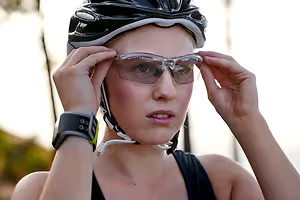
Sports Vision in Orlando
QUICK LINKS
Visual Health & Learning Center
Yes. Many children who do well playing T-ball begin struggling when they move to baseball because the smaller ball is more difficult to track. When a functional vision problem is identified and treated, many children find these activities become easier.
Yes. Athletes of every age depend on visual skills. Whether you're trying to improve your performance, become more consistent, or understand why certain sports feel more difficult, a developmental vision evaluation can help.
During a sports vision evaluation, our eye doctors evaluate eye tracking, eye teaming, focusing, depth perception, peripheral awareness, eye-hand coordination, and visual processing.
Sports vision training focuses on strengthening the visual skills athletes rely on during competition. It is often part of a broader vision therapy program that addresses functional vision problems identified during a developmental vision evaluation.
Yes. Even professional athletes recognize the importance of visual skills. Larry Fitzgerald has shared that the vision therapy he received as a child helped develop the visual abilities he relied on throughout his football career.
The first step is a developmental vision evaluation with one of our eye doctors. During this examination, we evaluate the visual skills that support sports performance and determine whether treatment may help.
The length of treatment depends on your diagnosis, your goals, and how your visual skills improve over time. Your eye doctor monitors your progress throughout treatment and adjusts your program as your skills improve.
Strong Visual Skills Help You Perform Your Best
Every sport depends on vision. Whether you're catching a baseball, returning a tennis serve, shooting a basketball, or tracking a soccer ball across the field, your eyes and brain work together to help you react quickly and accurately.
Many athletes have excellent eyesight but still struggle with the visual skills needed during sports. Eye tracking, depth perception, focusing, peripheral awareness, and hand-eye coordination all play an important role in athletic performance. If one or more of these visual skills aren't functioning efficiently, sports may feel more difficult than they should be.
Sports Require More Than Clear Eyesight
Seeing 20/20 is only one part of healthy vision. Your eyes also need to:
These visual skills are used every time you catch, throw, hit, kick, or aim.
Small Changes in Performance Can Point to a Vision Problem
Sometimes athletes don't realize they're working harder than they should. Instead, you may notice that:
-
Your eye-hand coordination gets worse as the game goes on.
-
Judging distance becomes more difficult when you're tired.
-
You find it harder to follow a moving ball than your teammates do.
-
You squint frequently during practice or competition.
-
You occasionally notice blurred or double vision.
-
You turn your head to use one eye more than the other.
-
Sports that require aiming or tracking are especially challenging.
-
You perform better with larger balls than with smaller ones.
-
No matter how much you practice, your performance doesn't improve the way you expect.
These signs don't always mean there's a vision problem, but they may indicate that your visual system isn't working as efficiently as it should.
Children Sometimes Show Vision Problems First on the Playing Field
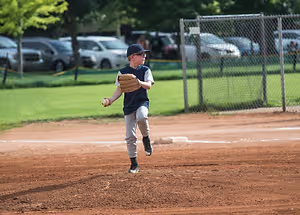
We've seen children who do well playing T-ball but begin struggling when they move to baseball. The smaller baseball is more difficult to track, making it harder to judge where the ball is and when to swing. Others may avoid catching, have difficulty judging distance, or seem hesitant during games even though they enjoy playing.
When a functional vision problem is identified and treated, many children find these activities become easier because they're using their visual skills more efficiently.
Vision Therapy Helps Improve the Visual Skills Used in Sports
If vision therapy is recommended, your treatment program is designed around the visual skills that need improvement. Much like physical therapy strengthens movement and coordination throughout the body, vision therapy strengthens the visual skills your eyes and brain use every day. Every program is based on your examination findings and your goals.
Athletes of Every Age Can Benefit From Strong Visual Skills
Children learning a new sport, high school athletes, college competitors, and adults who enjoy recreational sports all depend on the same visual skills.
Whether you're trying to improve your performance, become more consistent, or simply understand why certain sports feel more difficult than they should, a developmental vision evaluation can help identify whether your visual system is contributing.
Even professional athletes recognize the importance of visual skills. Larry Fitzgerald has shared that the vision therapy he received as a child helped develop the visual abilities he relied on throughout his football career.